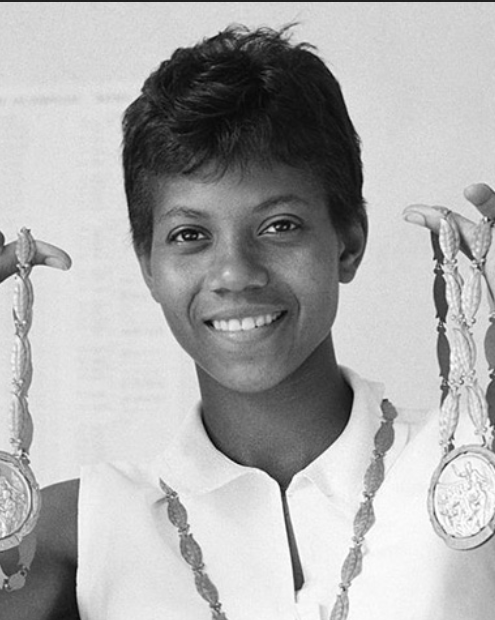
The story of Wilma Rudolph is an example of strength, perseverance, and self-belief. She proved that even the greatest difficulties cannot stop a person from pursuing their dreams and achieving incredible success.
Failures, Challenges, and Setbacks
- A difficult childhood — She was born prematurely and suffered from frequent illnesses from an early age.
- Age 5 — Polio — The disease weakened her left leg, and Wilma had to wear a special leg brace. She had difficulty moving around without assistance.
- A long recovery — Her mother took her to medical appointments, while her family members helped her regain mobility in her leg every day.
- Poverty and racial discrimination — She grew up in a large African American family in the American South, where racial segregation was widespread.
- Age 16 — Her first Olympic challenges — At the 1956 Olympic Games, she did not win an individual medal but earned a bronze medal in the 4 × 100-meter relay.
- Age 18 — Early motherhood — She gave birth to her daughter, Yolanda, before beginning her adult athletic career. She had to balance motherhood with training and education.
- Problems in her first marriage — Her marriage to William Ward ended in divorce. Biographical sources cite abuse as the reason.
- Challenges after her athletic career — After retiring from competitive sports, she had to seek new opportunities in education, employment, and community work.
Wilma Rudolph’s Achievements
- Overcame the effects of polio — She learned to walk without a leg brace and eventually began participating in sports.
- Age 16 — An Olympic bronze medal — In 1956, she won her first Olympic medal in the 4 × 100-meter relay.
- Age 20 — Three gold medals — At the 1960 Olympic Games in Rome, she won gold in the 100-meter and 200-meter races, as well as the 4 × 100-meter relay.
- Became a world-famous athlete — She was recognized as one of the fastest women in the world.
- Fought racial discrimination — She insisted that events held in her honor take place without racial segregation.
- Received recognition — In 1983, she was inducted into the U.S. Olympic Hall of Fame.
- Helped young athletes — After retiring, she participated in educational and sports programs for children and young people.
A Brief Timeline
- Age 4–5 — Suffered from serious illnesses, including polio.
- Age 12 — Learned to walk without a leg brace.
- Age 16 — Won a bronze medal at the 1956 Olympic Games.
- Age 18 — Became a mother and continued pursuing her athletic career.
- Age 20 — Won three gold medals at the Olympic Games in Rome.
- Age 22 — Retired from competitive athletics.
- Age 43 — Was inducted into the U.S. Olympic Hall of Fame.
- Age 54 — Died on November 12, 1994, from a brain tumor.
A Short Biography of Wilma Rudolph and Interesting Facts
Wilma Glodean Rudolph was born on June 23, 1940, in Tennessee, USA. She was born prematurely and suffered from frequent illnesses during her childhood. At the age of five, Wilma contracted polio, which seriously weakened her left leg.
Doctors feared that the girl might never be able to walk properly. However, her mother never lost hope. She took her daughter to medical appointments, while family members helped her with massages and rehabilitation exercises.
By the age of 12, Wilma had learned to walk without a leg brace. Later, she developed an interest in basketball and then began training in track and field.
At the age of 16, Wilma joined the U.S. Olympic team and won a bronze medal at the 1956 Olympic Games in Melbourne.
Four years later, at the 1960 Olympic Games in Rome, she achieved a historic result: she won three gold medals in the 100-meter race, the 200-meter race, and the 4 × 100-meter relay.
After retiring from competitive athletics, Wilma devoted herself to education, community work, and supporting young athletes.
She died in 1994 at the age of 54, but her story continues to inspire people around the world.
Interesting Facts
- She was one of 22 children in her family. Wilma grew up in a large family where her relatives supported her throughout her illness.
- Her childhood nickname was “Skeeter.” She was given this nickname because she was so active and energetic.
- She overcame the effects of polio. As a child, she had difficulty walking, but she eventually became an Olympic track and field champion.
- She won her first Olympic medal at the age of 16. Her first Olympic award was a bronze medal.
- She won three gold medals in Rome. This achievement made her one of the most famous female athletes of her time.
- She stood up against racial segregation. After the Olympics, Wilma insisted that celebrations held in her honor take place without racial restrictions.
- She helped young people. After retiring from competitive sports, Wilma supported the development of athletic programs for children and teenagers.
The Main Lesson: Why Is Wilma Rudolph’s Story Inspiring?
Wilma Rudolph’s story reminds us that the difficulties we face early in life do not necessarily determine our future.
As a child, she could not walk properly. She had to undergo years of treatment and rehabilitation before she was able to participate in sports.
But Wilma did not stop there.
She began training, took part in competitions, experienced defeats, and continued working toward her goal.
At the age of 16, she won her first Olympic medal, and at 20, she became a three-time Olympic champion.
Her life was not perfect. She faced discrimination, family difficulties, and the responsibility of raising a child. However, even after retiring from competitive sports, she continued helping others.
Wilma Rudolph’s story proves that the limitations we face in the past do not always determine the opportunities available to us in the future.
It does not matter how many times you have faced difficulties, how many times you have been told that you will never succeed, or how many obstacles have appeared along your path.
What matters is remembering that circumstances can change and that human abilities can develop.
This does not mean that simply believing in a dream is enough. Wilma’s success was made possible by medical treatment, family support, training, and years of hard work. Her story shows just how important perseverance and the support of others can be.
Do not let other people’s doubts become the only measure of your abilities. And do not treat the difficulties you have faced in the past as proof that your future has already been decided.
Perhaps today you are only at the beginning of your journey. Perhaps you have to start over after a failure or overcome circumstances that seem impossible to change.
But every new step can bring you closer to your goal.
Remember: sometimes, the journey toward great victories begins with the simplest desire of all — to try one more time.